










Woodpeckers are famous for repeatedly hammering their beaks against tree trunks. But there's another fascinating feature hidden inside their heads.
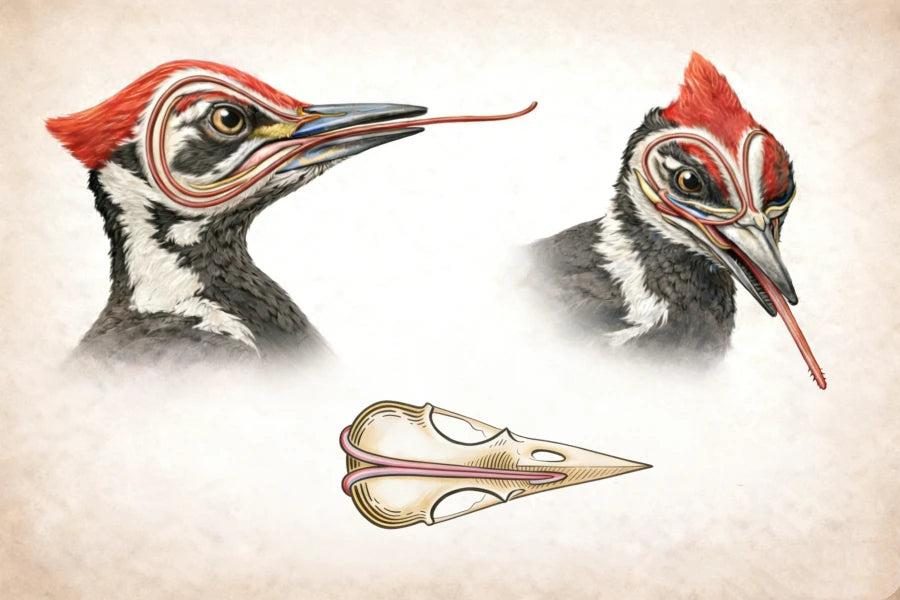
Their tongues are supported by an unusual anatomical structure called the hyoid apparatus.
Unlike the relatively short tongue-supporting structures found in many birds, a woodpecker's hyoid apparatus is extremely elongated. Its supporting bones extend around the back of the skull and toward the upper beak.
This arrangement allows the bird to extend its tongue far beyond the tip of its bill.
Why does it need such a long tongue?
Woodpeckers search for insects hidden inside tree bark and narrow holes. Their specialized tongues help them reach deep into these spaces and retrieve food that their beaks alone cannot easily access.
Depending on the species, the tongue may also have pointed tips, backward-facing barbs, or sticky surfaces that help capture insects.
The structure is so unusual that scientists have examined woodpecker skulls using detailed anatomical imaging to understand how the tongue-support system is arranged.
It's a remarkable adaptation that turns an ordinary-looking bird into a highly specialized insect hunter.