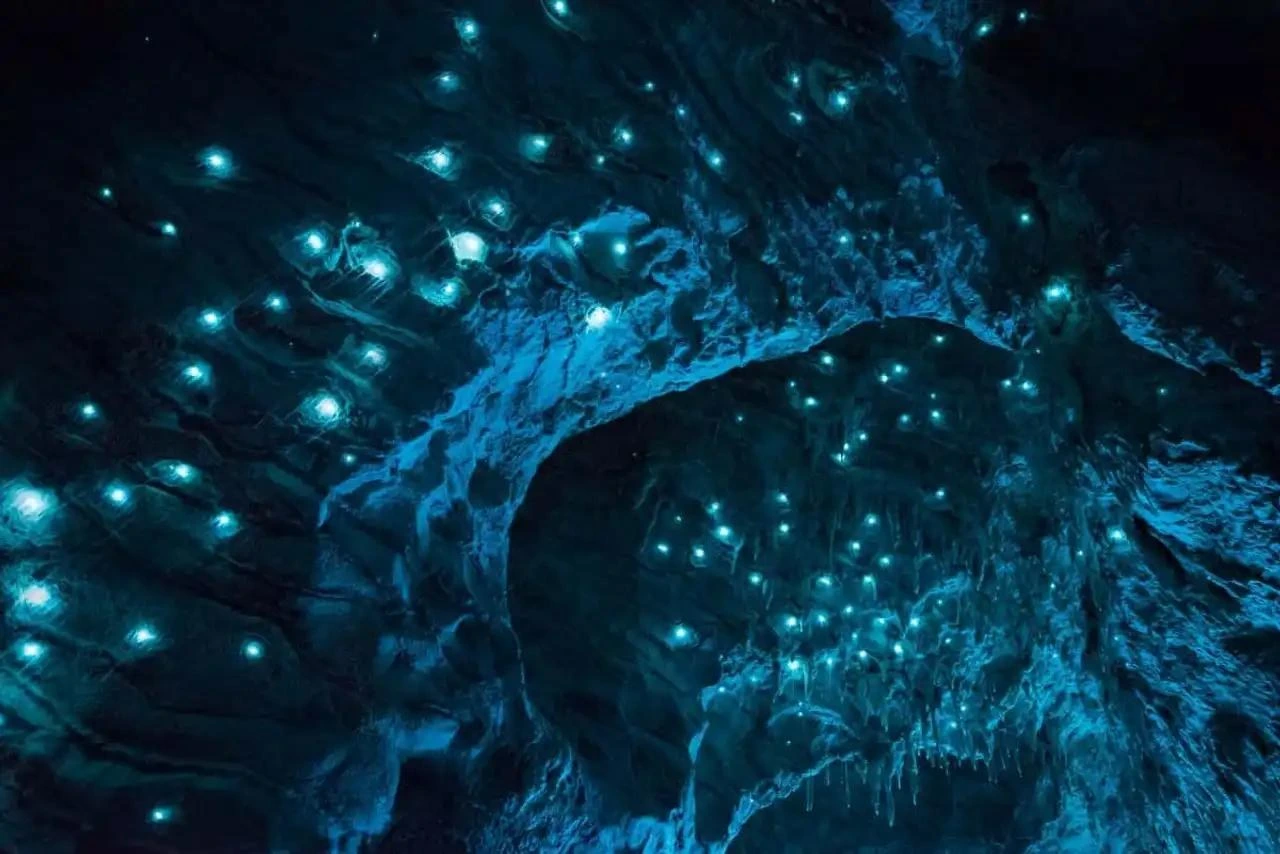


Deep beneath New Zealand’s surface, there are caves where thousands of tiny living creatures create a glowing display that looks like a star-filled night sky.
These are the Waitomo Glowworm Caves, located on New Zealand’s North Island.
Their famous blue-green lights come from glowworms called Arachnocampa luminosa, a species native to New Zealand. Despite their name, these creatures are actually the larvae of fungus gnats, not ordinary worms.
The larvae produce light through a natural chemical reaction called bioluminescence. They use this glow to attract insects toward long, sticky silk threads hanging from their bodies.
When flying insects are drawn toward the light, they can become trapped in these threads and provide food for the larvae.
Inside the dark caves, thousands of these tiny lights create an incredible effect across the ceilings. From a boat moving quietly through the cave, visitors can see what looks like a glowing galaxy above them.
The caves were explored by local Māori chief Tane Tinorau and English surveyor Fred Mace in 1887. They later became one of New Zealand’s best-known natural attractions.
The glowworms are sensitive to their environment, so visitors are expected to follow rules that protect the delicate cave ecosystem.
Would you take a boat ride underneath thousands of living lights?