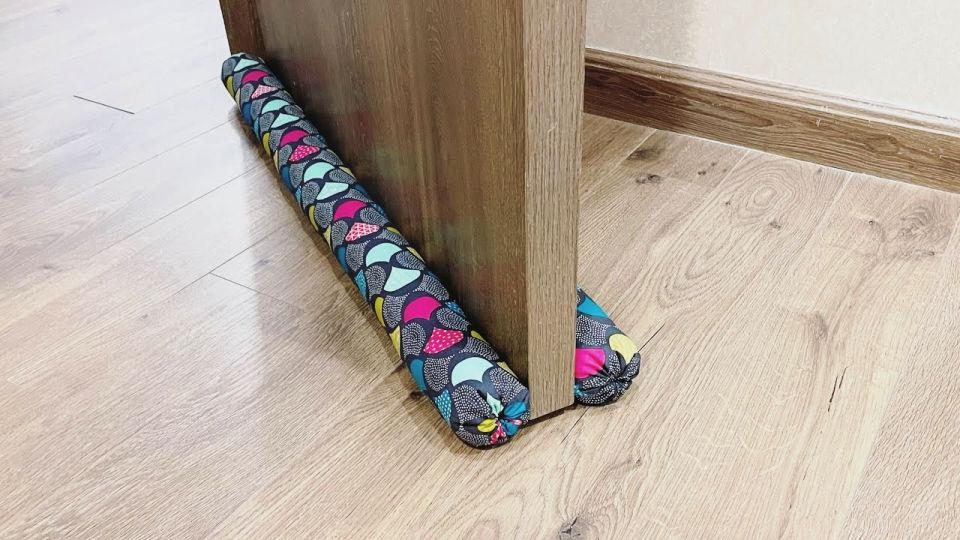


STOP UNWANTED AIR FROM ENTERING YOUR HOME.
Small gaps underneath doors can let outside air, dust, light and noise enter your living space. A simple fabric door draft stopper helps cover that gap while giving old towels, leftover fabric or unused textiles a practical second life.
It is inexpensive, beginner-friendly and can be customized to match your room.
WHAT YOU'LL NEED
- Thick leftover fabric, canvas or an old towel
- Measuring tape
- Scissors
- Needle and strong thread or a sewing machine
- Fabric pins or clips
- Polyester stuffing or clean fabric scraps
- Optional filling material for added weight
- Funnel, if using loose filling
- Fabric glue or hook-and-loop tape, if you prefer a no-sew finish
STEP-BY-STEP INSTRUCTIONS
- Measure the bottom of your door
Close the door and measure its width. Check the gap between the door and the floor.
Your finished draft stopper should be slightly longer than the door width so it covers the entire opening.
- Choose your fabric
Select a thick, durable fabric that can handle regular movement across the floor.
Canvas, denim, old towels and heavy cotton are useful choices.
Avoid delicate materials that can tear easily or collect too much dirt.
- Cut the fabric
Cut a long rectangular piece of fabric. A practical starting point is around 15 to 20 cm wide, with the length based on your door measurement.
Leave additional fabric for seams and finishing the ends.
- Fold and secure the fabric
Fold the fabric lengthwise with the patterned or finished sides facing inward.
Secure the long edge with pins or clips. This will become the main seam of your fabric tube.
- Sew the long edge
Sew along the long open edge, leaving a seam allowance of approximately 1 to 1.5 cm.
Secure the stitching at both ends. If you do not have a sewing machine, use strong hand stitching or a suitable fabric adhesive according to its instructions.
- Close one end and turn it inside out
Close one short end of the fabric tube.
Turn the fabric right side out so the seam is hidden inside. You should now have a long fabric sleeve with one open end.
- Add the filling
Insert polyester stuffing, clean fabric scraps or another suitable filling material.
For a heavier stopper, you can use a separate sealed inner pouch filled with clean, dry rice or similar material. Keep loose filling fully enclosed so it cannot spill.
Distribute the filling evenly along the length.
- Close the remaining end
Fold the open fabric edge inward and sew it securely.
Check that the filling cannot escape and that both ends are firmly closed.
- Test the fit
Place the stopper along the bottom of your closed door.
Check that it covers the gap without preventing the door from closing or creating a tripping hazard.
If it is too long, adjust the ends. If it is too short, add a properly finished fabric extension.
- Clean and maintain it
Remove dust regularly and clean the fabric according to its material and filling.
If you use natural filling, keep the stopper dry to prevent moisture and mold problems.
DESIGNER TIP
Use an old pair of jeans, a patterned curtain or leftover upholstery fabric to create a more attractive finish.
You can also make a removable outer sleeve with a zipper or hook-and-loop closure so the cover is easier to wash.
EXTRA NOTE
This project can help reduce drafts and unwanted light around a door, but it will not replace proper weatherstripping or insulation. For doors that lead outdoors, consider sealing the actual gaps as well.
Would you make one using old clothes or buy new fabric for it?
Save this simple project and give unused fabric a useful purpose.