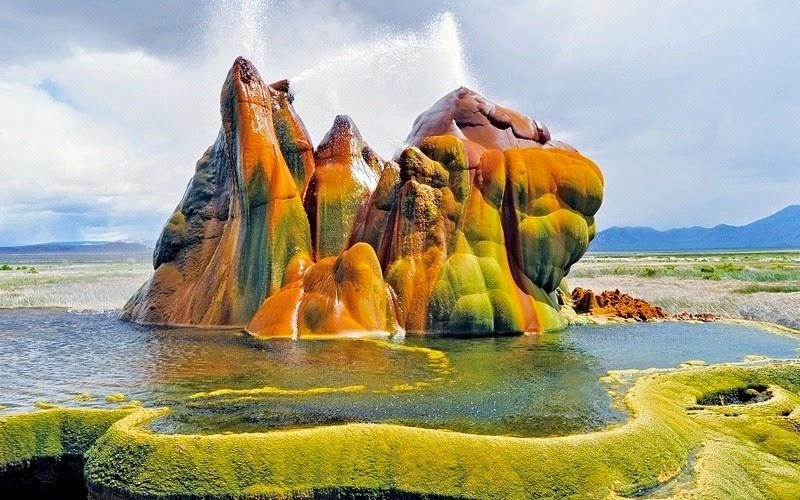








Imagine a fountain rising from the middle of a desert, surrounded by layers of bright red, orange, yellow and green formations. It looks like a colorful alien sculpture, but this unusual landmark was created through a combination of human activity and natural geothermal processes.
Fly Geyser is located at Fly Ranch in Nevada’s Black Rock Desert. Unlike many famous geothermal formations, it was not created entirely by nature. Its story began with well drilling in the early 20th century, when people were searching for water in the area.
A later geothermal drilling project in 1964 created another well that was not properly sealed, allowing hot water to escape continuously.
As the mineral-rich water reached the surface, it began depositing dissolved minerals around the opening. Layer after layer accumulated, gradually building the unusual cone-shaped formations that can be seen today. The water continues to flow, adding new mineral deposits and slowly changing the landscape.
One of the most fascinating features is its vibrant color. The red, orange and green shades come from mineral deposits and heat-loving microorganisms that thrive around the warm water. These colors spread across the terraces, giving the geyser its distinctive rainbow-like appearance.
The flowing water has also created a series of small pools and terraces around the main formations. Instead of looking like a single fountain, the entire area resembles a miniature geothermal world, with several colorful mounds surrounded by water.
Fly Geyser is a striking example of how human activity can unintentionally create a remarkable landscape when it interacts with natural geological processes. Today, it is part of Fly Ranch, a property stewarded by the Burning Man Project.
Although it looks like an open tourist attraction, the geyser is on private property and can only be visited through authorized guided nature walks. Its unusual beauty is worth discovering, but it is important to respect the land and its access restrictions.