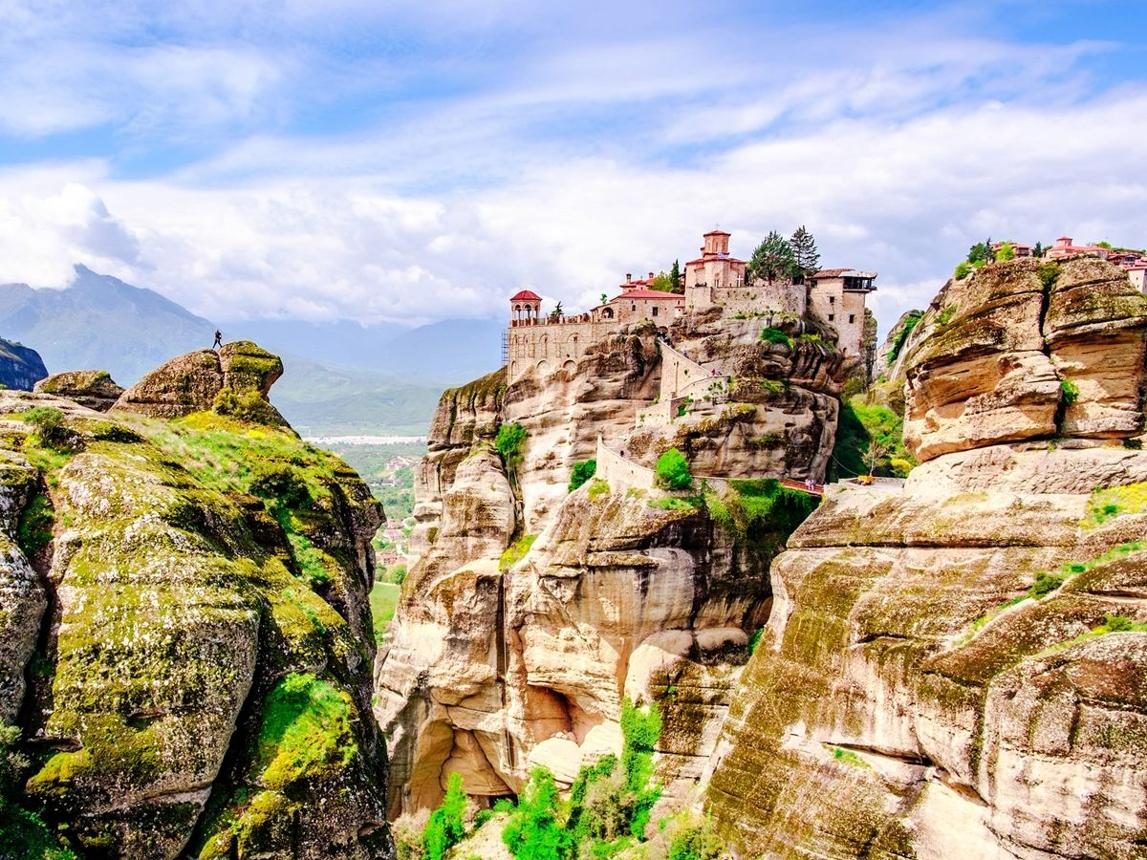



Imagine seeing enormous stone pillars rising hundreds of meters above a green valley, with ancient monasteries sitting on top of them as if they were floating in the sky.
This is Meteora, one of Greece’s most extraordinary destinations, located near the town of Kalambaka in the Thessaly region. Its name comes from a Greek word meaning “suspended in the air,” which perfectly describes its unusual appearance.
The massive rock formations were created from layers of sediment deposited by ancient rivers and other geological processes millions of years ago. Over time, tectonic movements, rain and wind gradually shaped the softer material into towering pillars, steep cliffs and isolated rock formations.
What makes Meteora even more remarkable is how people built religious communities on top of these difficult-to-reach rocks. Hermits began settling in the area around the 11th century, seeking quiet places for prayer and isolation.
Eventually, monasteries were constructed on the highest pillars, some with incredibly limited access.
At one point, 24 monasteries were built throughout the region. Historically, reaching them was extremely difficult. Monks and supplies were transported using ladders, ropes, nets and pulley systems. Some monasteries could only be reached by being lifted up the cliffs in large nets.
Today, six monasteries remain active and can be visited, including Great Meteoron, Varlaam, Roussanou and Holy Trinity. Visitors can climb stairways and follow pathways that lead to these historic buildings, where they can discover religious artwork, old manuscripts, courtyards and centuries-old architecture.
The scenery changes dramatically throughout the day. In the morning, mist sometimes surrounds the rock pillars, making the monasteries appear to float above the clouds. At sunset, warm light illuminates the cliffs and creates dramatic shadows across the valley.
Meteora is recognized as a UNESCO World Heritage Site for both its remarkable geological landscape and its historical religious communities. It is a place where nature created the foundations for one of humanity’s most extraordinary architectural achievements.