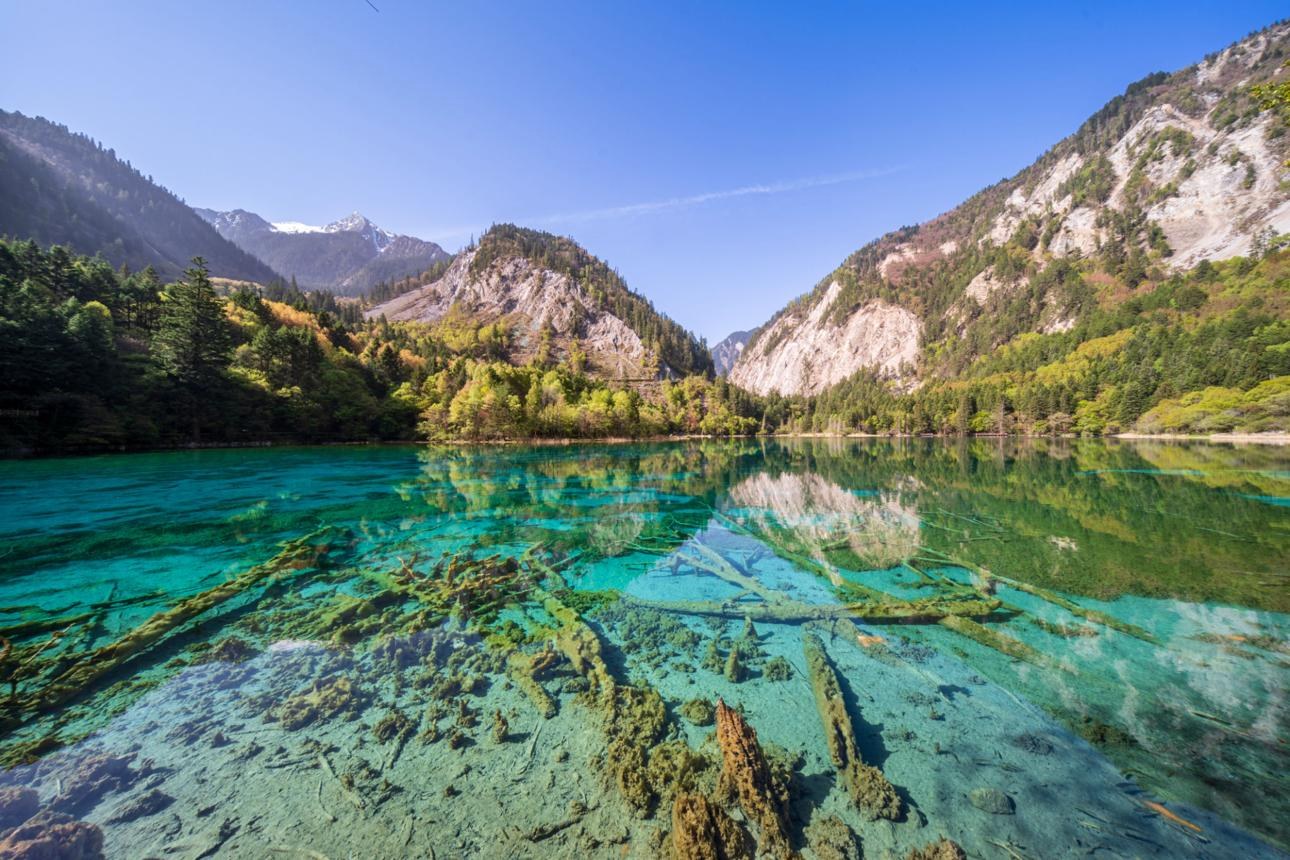

Imagine walking through a mountain valley where the lakes look like giant pools of turquoise, emerald green, deep blue and golden yellow. Some are so clear that you can see fallen tree trunks resting beneath the water, almost as if they are floating in midair.
Jiuzhaigou Valley is located in the northern part of Sichuan Province, China, surrounded by dramatic mountains, dense forests and snow-covered peaks. Its name is often translated as “Valley of Nine Villages,” referring to the Tibetan villages historically found in the area.
What makes this destination especially unusual is the way its lakes and waterfalls form a connected natural landscape. Water flows from one lake to another, passing over limestone terraces and natural mineral barriers.
Over thousands of years, calcium carbonate from the water has accumulated around rocks, plants and fallen trees, creating beautiful stepped formations.
The different shades of the lakes are influenced by several factors, including water depth, suspended minerals, aquatic plants and the way sunlight enters the water. During autumn, the surrounding forests turn brilliant shades of red, orange and gold, creating colorful reflections across the lakes.
The valley is also home to diverse wildlife and plant species, including endangered animals such as the giant panda. It is not simply a beautiful collection of lakes. It is a remarkable natural environment where forests, waterfalls, mineral formations and mountain ecosystems exist together.