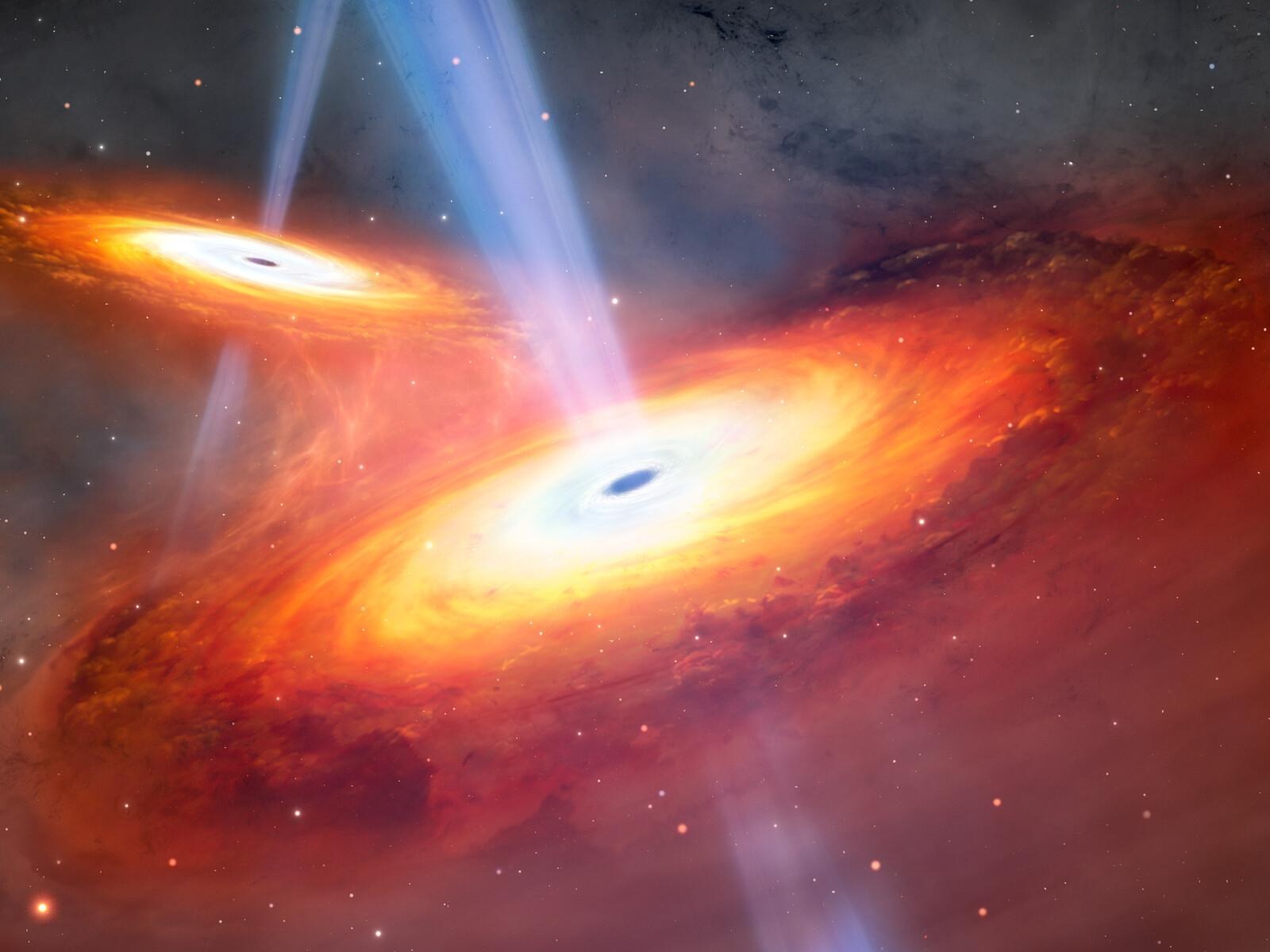



Astronomers using the James Webb Space Telescope have discovered an extraordinary pair of quasars from the early universe.
Quasars are extremely bright objects powered by supermassive black holes. As matter falls toward a black hole, it heats up and releases enormous amounts of energy, sometimes outshining the entire galaxy around it.
The newly identified pair, designated J1602+4228AB and nicknamed Nāpōwawāʻenakaulua, existed when the universe was only around 900 million years old.
What makes them so unusual is their size and closeness. One black hole is estimated to have around 1.5 billion times the mass of the Sun, while the other has around 400 million solar masses. They are separated by approximately 18,100 light-years.
That is an incredibly small distance for two objects this massive, especially so early in cosmic history.
Scientists are still trying to understand how such enormous black holes grew so quickly. The discovery could help researchers investigate how the earliest galaxies formed and interacted.
DID YOU KNOW? The universe is approximately 13.8 billion years old, meaning these quasars are being observed as they existed when the universe was still very young.